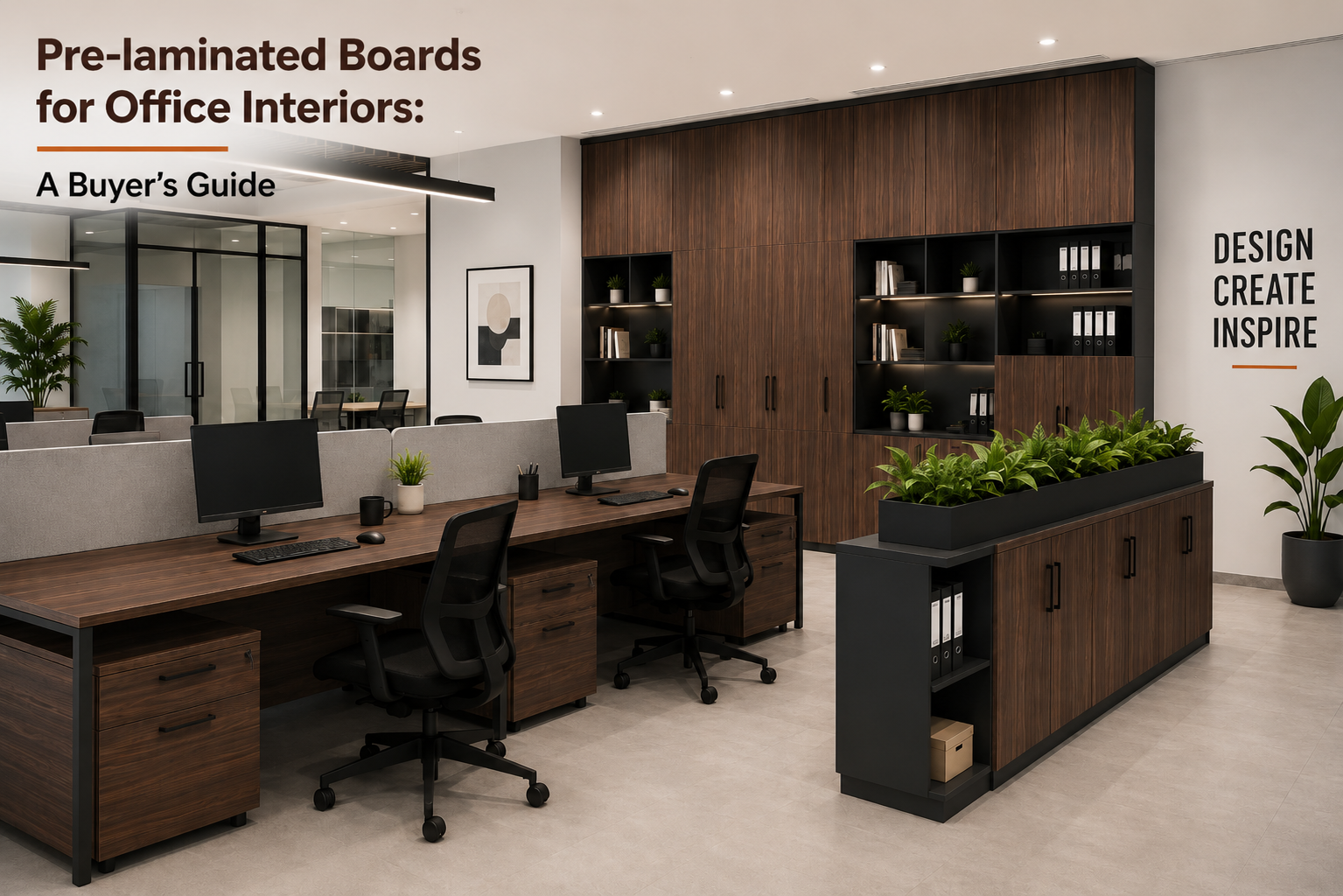
Pre-laminated Boards for Office Interiors: A Buyer’s Guide
Pre-laminated particle boards for office interiors have become the industry standard for modern Indian workplaces. From corporate headquarters to co-working spaces, this high-performance material delivers a clean, premium look without the heavy cost of solid wood.
If you manufacture office furniture or source materials for commercial interior projects, this quick guide will help you make the right call before your next bulk order.
📋 Table of Contents
- Why Modern Designers Prefer Pre-Laminated Particle Boards for Office Interiors
- What “Pre-laminated” Actually Means for Commercial Projects
- 5 Proven Factors for Bulk Particle Board Orders
- Bagasse vs Woodchip — Which Works Best for Office Projects?
- Questions to Ask Your Board Supplier Before a Commercial Order
- Why Your Board Choice Reflects Your Business Reputation
Why Modern Designers Prefer Pre-Laminated Particle Boards for Office Interiors
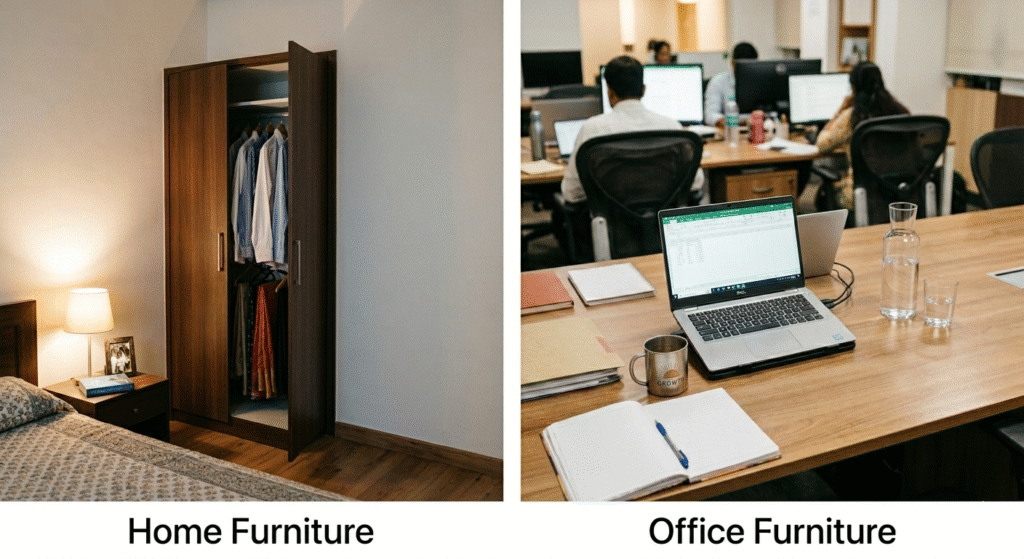
Office furniture is not the same as residential furniture — and the material requirements reflect that difference clearly.
A wardrobe at home gets opened twice a day. A storage cabinet in an office gets accessed thirty times. Workstation surfaces carry laptops, monitors, coffee mugs, and files — all day, every day, five or six days a week.
The boards you choose for office furniture manufacturing need to deliver on three things simultaneously:
- Consistent surface quality across large batch orders
- Durability under heavy daily use
- A finish that does not look tired after twelve months of real-world use
That is exactly where the right prelam boards for office furniture create a measurable advantage over traditional material choices.
What “Pre-laminated” Actually Means for Commercial Projects
Pre-laminated boards arrive at your workshop factory-finished and ready to cut, drill, and assemble—no manual lamination required.
For large corporate projects like fifty workstations or two hundred storage units, choosing pre-laminated particle boards for office interiors isn’t just a convenience; it’s a production necessity. Manual, workshop-level lamination on large orders leads to inconsistent textures, color mismatches, and delayed timelines that eat into your margins. Factory finishing eliminates all three risks instantly.
To understand the full range of options available, it helps to start with a trusted pre-laminated particle board manufacturer in India — and know the two core board types and how each performs in commercial settings.
Pre-laminated boards solve all three problems before the boards even leave the factory.
Not all pre-laminated particle boards perform equally in commercial environments. Here is what to check specifically before committing to a large-quantity order for an office interior project.
5 Proven Factors for Bulk Particle Board Orders
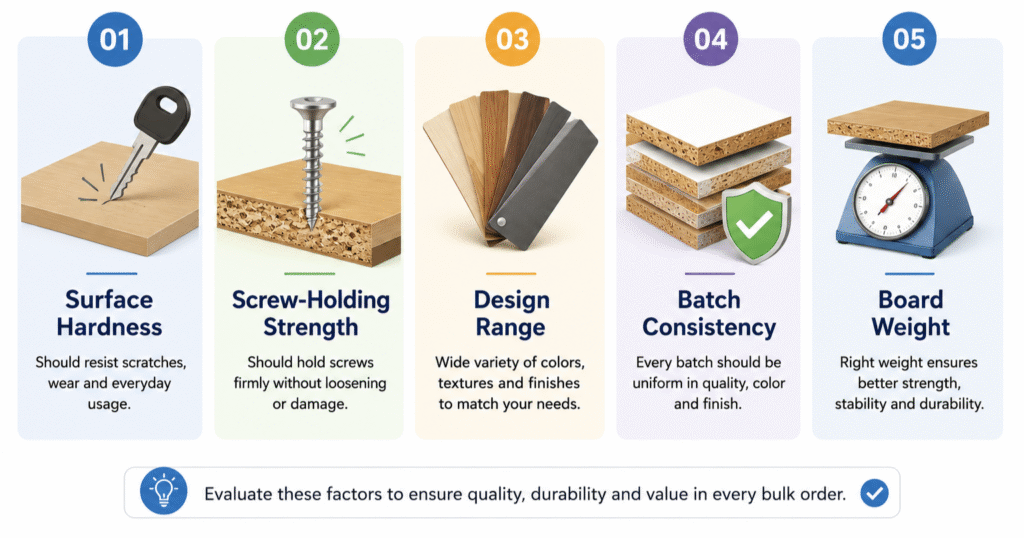
1. Surface Durability and Scratch Resistance
Office workstation tops take daily contact — keyboards sliding, coffee cups, files, and elbows. Look for boards with a hard-wearing laminated surface and ask your supplier about surface hardness ratings before ordering at scale.
2. Screw-Holding Strength
Office furniture gets reconfigured when companies move or redesign spaces. Boards with poor screw-holding strength strip at joints after one relocation. Uniform-density woodchip particle boards perform significantly better here than lower-density alternatives.
3. Design Range
Corporate interior designers now specify solid tones, muted textures, and contemporary finishes — not just standard wood grain. Your supplier’s design catalogue depth directly affects how competitive your quotes look. If you cannot match a designer’s brief, you risk losing the order entirely.
4. Batch Consistency on Reorders
On large commercial projects, a reorder two weeks after the first delivery must match the original batch exactly. Confirm this capability with your supplier upfront — not after a colour mismatch shows up mid-installation.
5. Board Weight and Site Handling
Office fit-outs frequently happen in occupied buildings — upper floors, narrow corridors, passenger elevators. Boards that are lighter than plywood make installation noticeably faster and reduce physical strain on your team. This is a practical advantage most buyers overlook until they are already mid-project.
Bagasse vs Woodchip — Which Works Best for Office Projects?
Both board types serve commercial interior projects well — but they suit different project briefs. Here is a simple way to think about it:
| Board Type | Best Suited For | Key Advantage |
|---|---|---|
| Bagasse Particle Board | Green-certified or ESG-aligned office projects, LEED buildings, sustainability-focused corporate clients | Made from sugarcane residue — a genuine eco-friendly credential your client can document and communicate |
| Woodchip Particle Board | High-volume commercial manufacturing — workstations, storage units, conference room furniture | Uniform density, strong screw-holding, consistent performance across large production runs |
💡 Practical tip: Most experienced furniture manufacturers use both board types on large commercial projects — Bagasse for visible surface panels where the eco story adds client value, and Woodchip for carcass and structural components where density and strength are the priority.
Questions to Ask Your Board Supplier Before a Commercial Order
A supplier who can answer all of these clearly — without hedging — is worth building a long-term relationship with:
✅ Pre-order Supplier Checklist
- Can you confirm batch-to-batch colour consistency for reorders during this project?
- What is the surface hardness specification for this board range?
- What is the density and screw-holding strength for your woodchip boards?
- How many design options do you carry — and are they available for immediate supply?
- What are your lead times for bulk quantities delivered to my city?
- Do you offer Bagasse particle board options for sustainability-focused project briefs?
Why Your Board Choice Reflects Your Business Reputation
In commercial interiors, referrals drive growth. A flawless project wins your next big client, while a single failure—scratched surfaces, warped joints, or mismatched colors—can instantly damage your market reputation.
The materials you specify directly reflect your quality standards. For high-traffic commercial spaces, opting for durable pre-laminated particle boards for office interiors ensures long-term performance, protecting both your project’s integrity and your business reputation.
Final Thought
Choosing the right pre-laminated particle boards for office interiors comes down to four things: surface performance, batch consistency, design flexibility, and a supplier who understands the commercial furniture industry well enough to support your project requirements reliably.
These are not difficult standards to meet — but they do require working with a manufacturer who has invested in both product quality and operational reliability over the long term.
If you are evaluating board options for an upcoming commercial project, it is worth speaking with a manufacturer who has been supplying India’s furniture industry for over two decades and has the design range, supply network, and track record to back it up.